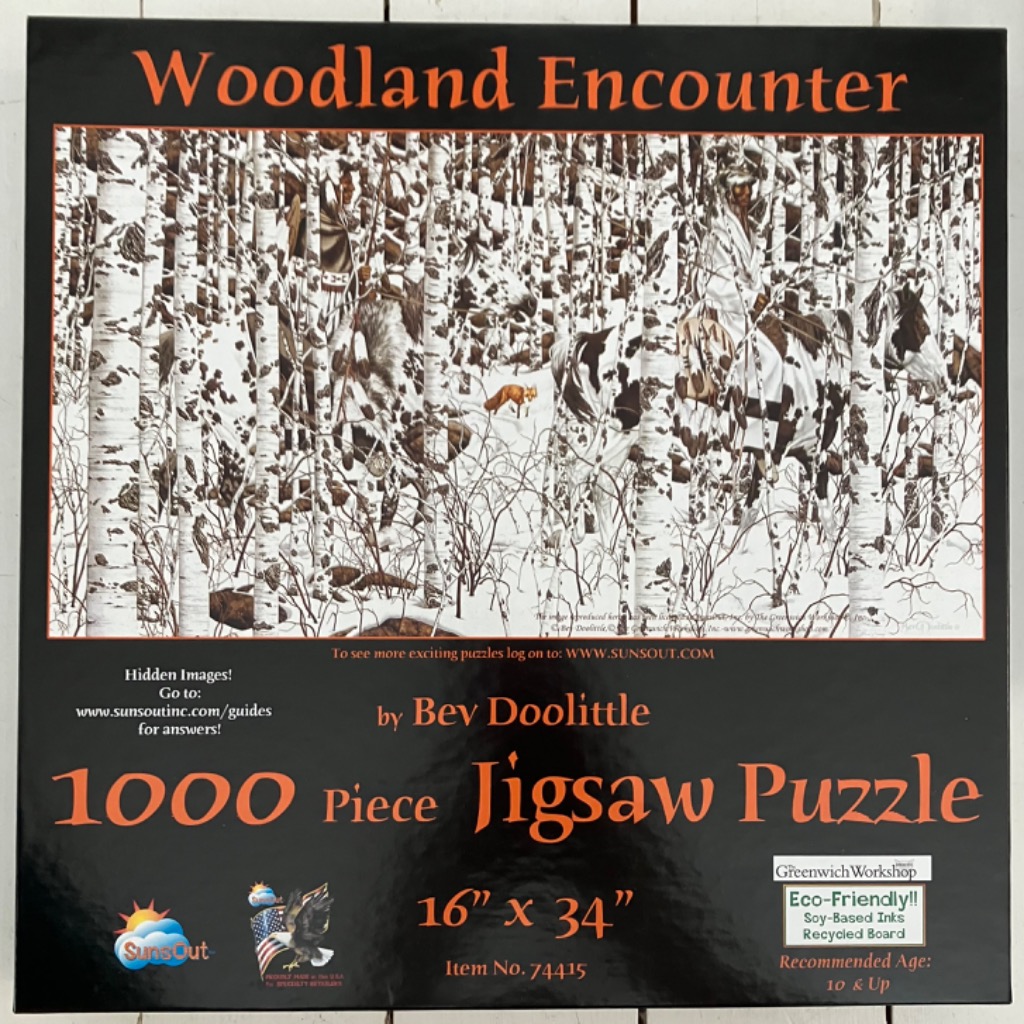
The central artwork depicts a dense winter forest dominated by vertical white and grey birch tree trunks. Within this camouflage scene, two Native American riders on horseback are partially obscured by the trees. One rider is positioned toward the left, clad in brown and tan tones, while the other is toward the right, wearing white and grey. Their horses feature spotted and mottled coats that blend seamlessly into the patterns of the snowy bark, making them appear as if they are emerging from the woods.
The setting is a snow-covered landscape during winter. The composition is highly complex, utilizing optical illusion to hide the figures within the repetitive vertical lines of the trees. A small, bright orange fox stands in the middle ground, providing a singular, sharp point of high-contrast colour against the muted greys, browns, and whites of the scene. The ground is covered in light, powdery snow, with faint traces of brush and dark earth peeking through.
The style is a detailed, realistic watercolor painting characteristic of camouflage art. The lighting is diffuse and soft, consistent with an overcast winter day in the wilderness. The overall mood is quiet, elusive, and contemplative, inviting the viewer to search the intricate patterns to locate the figures. The imagery relies heavily on negative space and natural textures to create the effect of the riders being one with their environment.