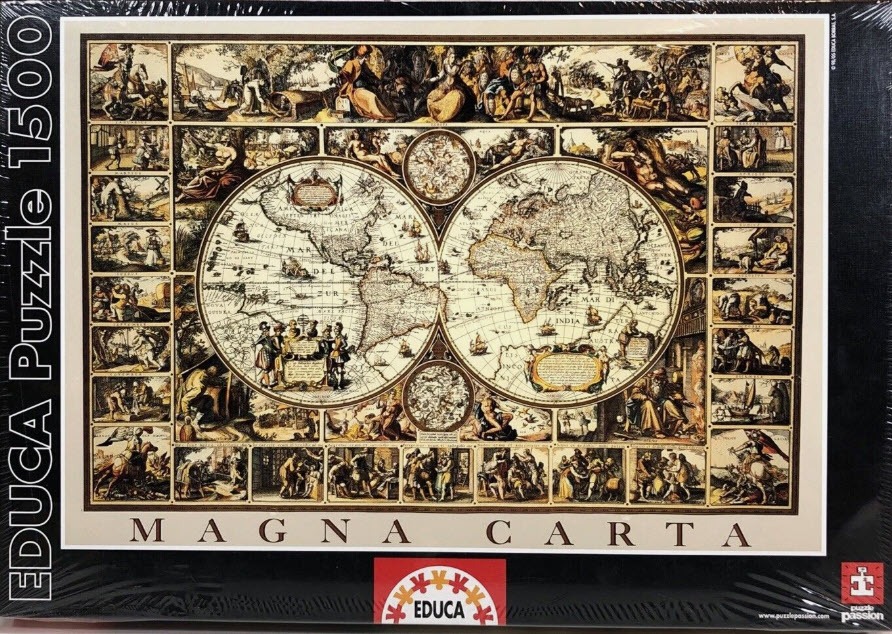
The central focus is a historical, double-hemisphere world map executed in a classical cartographic style. The two circular maps dominate the composition, depicting the continents as they were understood in early modern geography. Small illustrations of ships sail across the oceans, and decorative cartouches contain Latin inscriptions. Two smaller circular star charts are situated between the hemispheres, depicting celestial constellations. The entire map is rendered in an antique, parchment-toned palette with sepia-toned ink lines.
Surrounding the map is a dense border composed of rectangular vignettes. These individual panels depict a variety of scenes, including classical mythological figures, historical explorers, and allegorical representations of the continents. Each panel is intricately detailed, showing figures in period clothing, active poses, and complex settings ranging from landscapes to interior scenes. The framing creates a structured grid that frames the globes, giving the composition the appearance of a scholarly or decorative atlas plate from the seventeenth century.
The overall colour scheme is muted and aged, relying on warm shades of cream, beige, brown, and dark ink accents to evoke the feel of an old print. The lines are fine and descriptive, emphasizing the classical illustration style. The layout is highly symmetric and scholarly, presenting a dense accumulation of geographical, historical, and astronomical knowledge typical of baroque-era decorative arts.