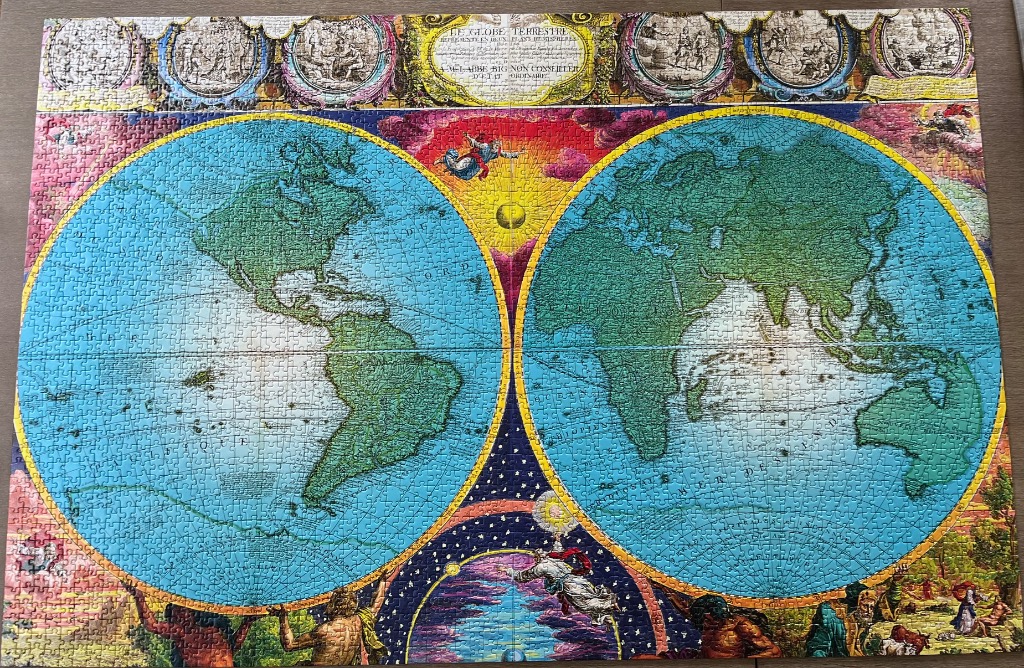
This vintage-style illustration presents a world map divided into two large, circular hemispheres set against a detailed, decorative background. The left hemisphere depicts the Americas, while the right hemisphere shows Europe, Africa, Asia, and Australia. The landmasses are rendered in shades of green, set against deep blue oceans marked with faint lines of latitude and longitude. The overall style is reminiscent of 17th-century cartography, with aged parchment textures and elaborate artistic flourishes.
Surrounding the two primary spheres are vivid scenes featuring mythological figures, celestial bodies, and landscapes. At the top, a series of smaller, framed circular vignettes showcase historical or allegorical scenes, accompanied by central text titled "LE GLOBE TERRESTRE." Below the map, a central arch depicts a dark, star-filled sky with clouds and planetary motifs. Throughout the corners and lower sections, various human figures, some in classical attire, are positioned amidst natural landscapes, adding a sense of narrative to the scientific subject matter.
The colour palette is rich and warm, contrasting the bright blue water and green continents with deep reds, purples, and gold accents found in the border work and decorative elements. The lighting throughout the image suggests an illuminated manuscript or an antique copperplate print. The composition is balanced and formal, designed to evoke the wonder of geographical discovery and the intersection of science and mythology prevalent in early modern mapmaking.