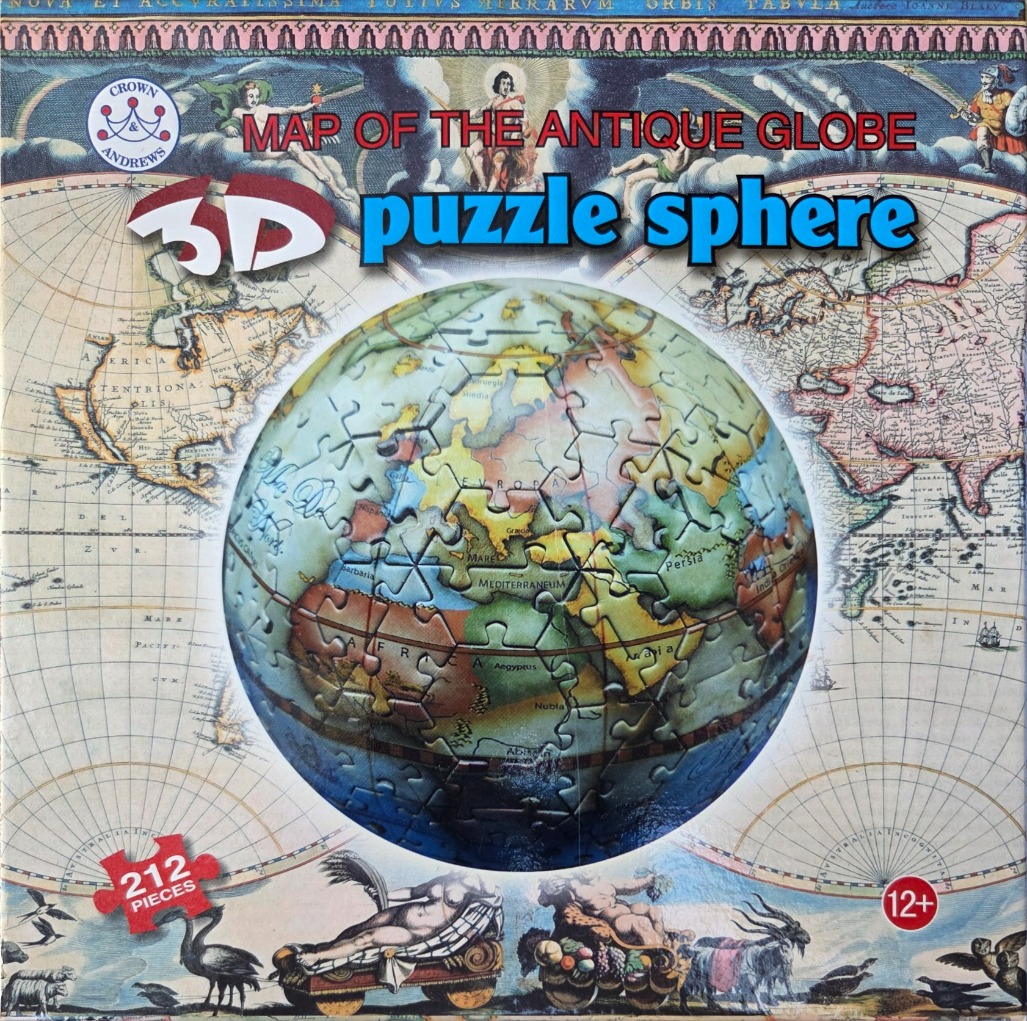
The central focus is a spherical, three-dimensional representation of an antique world map. This sphere showcases the continents of Europe, Africa, and parts of Asia, rendered in muted, earthy tones of tan, deep green, and burnt orange. The geography is labeled with historical nomenclature, such as "Mare Mediterraneum," "Africa," and "Persia," all set against a background of nautical grid lines and curved longitudinal and latitudinal markings.
The sphere is framed by a wider, flat-art decorative border inspired by 17th-century cartography. This surrounding area features classical, mythological illustrations, including winged figures in the upper corners and reclining figures in chariots at the base, accompanied by fantastical creatures like a goat with long horns. The entire scene is steeped in a sepia-toned, parchment-like aesthetic, giving the composition the appearance of an aged, hand-drawn map or engraving.
Lighting across the globe gives it a tangible, rounded presence, with subtle shading on the edges to emphasize its spherical shape against the flatter, ornate background. The overall style is reminiscent of Renaissance exploration prints, combining scientific cartography with artistic flourishes and classical iconography to evoke a sense of historical discovery and adventure.