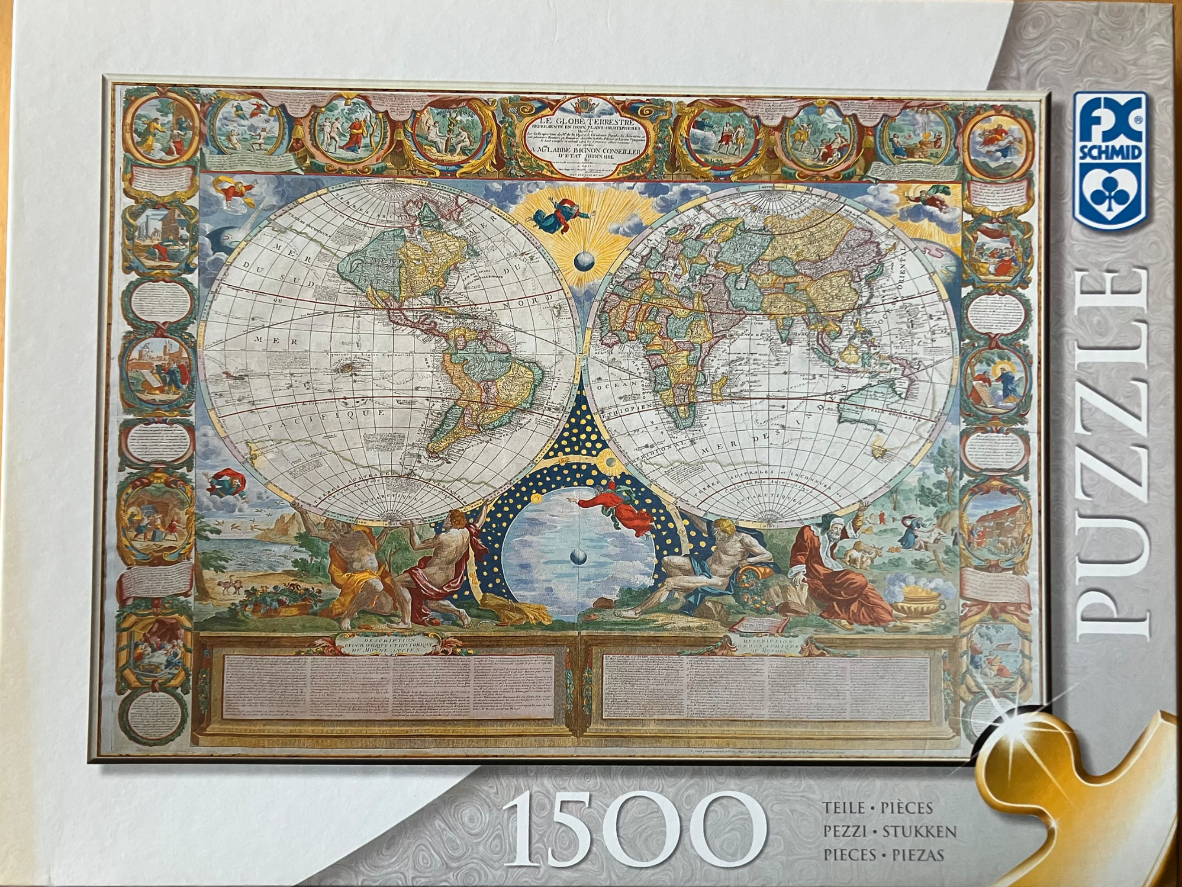
The central image is a highly detailed, antique-style double-hemisphere map of the world. Two large circles dominate the center, depicting the continents in muted, parchment-toned colors with delicate ink lines detailing coastlines and topographical features. The map is set against a backdrop of deep blue space, dotted with stars and celestial bodies. The Western Hemisphere encompasses the Americas, while the Eastern Hemisphere displays Europe, Africa, and Asia. Both spheres are marked with intricate grids of latitude and longitude lines, typical of classical cartography.
The map is framed by a sprawling, elaborate border filled with small, circular vignettes illustrating mythological scenes, pastoral landscapes, and historical depictions. At the bottom, muscular, classical figures—reminiscent of Greek titans or gods—are shown interacting with the spheres, one group supporting a hemisphere while the other gestures towards the heavens. Below these figures, wide decorative panels are filled with densely packed, elegant calligraphic text providing geographical and historical descriptions.
The color palette is warm and earthy, dominated by aged paper tones of cream, tan, and soft gold, contrasted by deep midnight blues in the celestial areas and muted reds and greens in the decorative borders. The style is that of an 17th or 18th-century copperplate engraving or hand-colored map, characterized by ornate baroque flourishes and a formal, scholarly aesthetic that emphasizes both scientific discovery and artistic tradition.