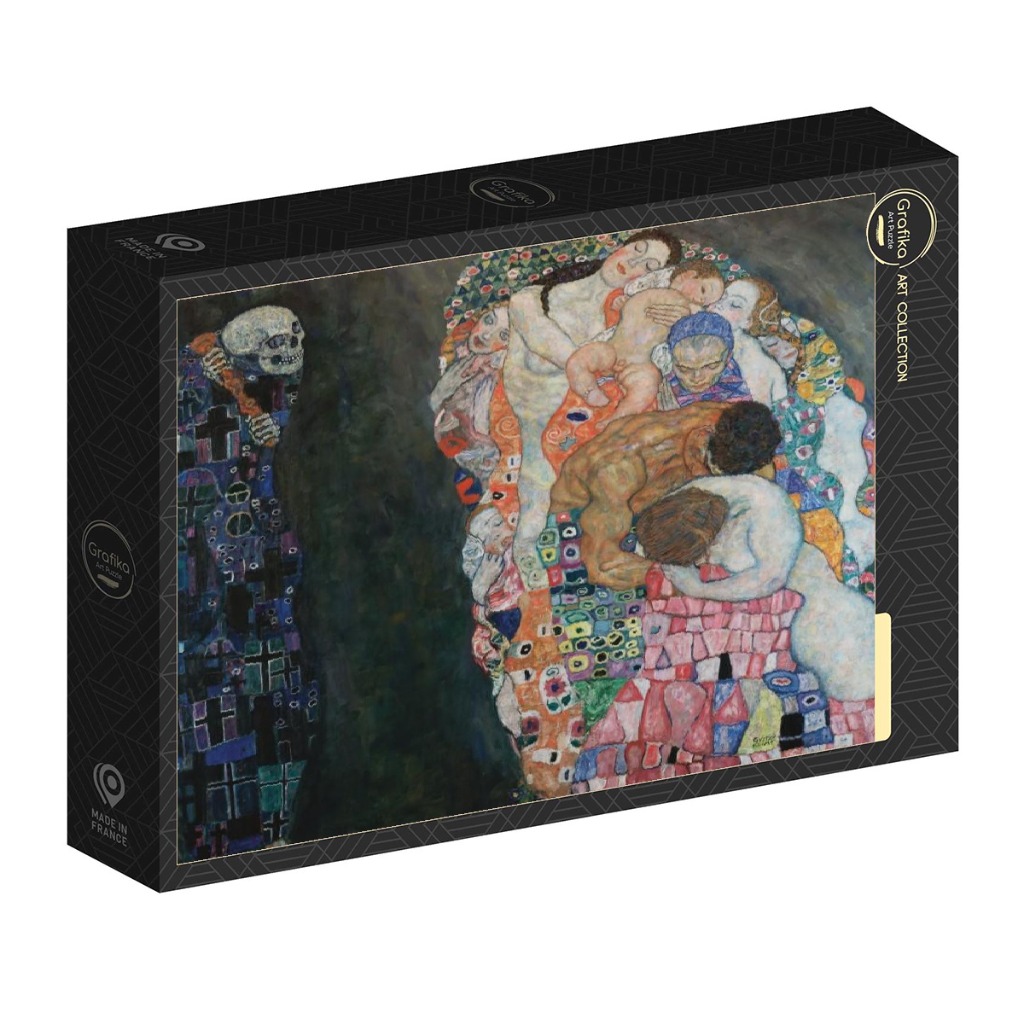
The artwork depicts the duality of existence through a striking contrast between life and death. On the right, a dense, vertical cluster of humanity is shown huddled together, representing different stages of life, including children, women, and a man, all intertwined and wrapped in decorative, patterned fabrics. To the left, a solitary, menacing figure of Death, portrayed as a cloaked skeleton holding a club, stands apart, observing the group with a fixed, skull-like gaze.
The composition is split sharply by a vast, dark, and empty space that separates the living from the skeletal figure. The background behind the living group is textured and filled with intricate floral and geometric motifs, creating a sense of ethereal warmth and complexity. In contrast, the space surrounding Death is a deep, shadowy void, emphasizing the encroaching finality he represents.
The colour palette is a mix of muted, earthy tones in the background and vibrant, ornamental patches of red, blue, green, and gold within the garments of the living. The style is distinctly symbolic and Art Nouveau in its focus on decorative surface patterns, fluid lines, and an allegorical approach to human experience. The figures are rendered with soft, painterly strokes, highlighting the vulnerability of the flesh against the rigid, stark presence of the skeletal figure.