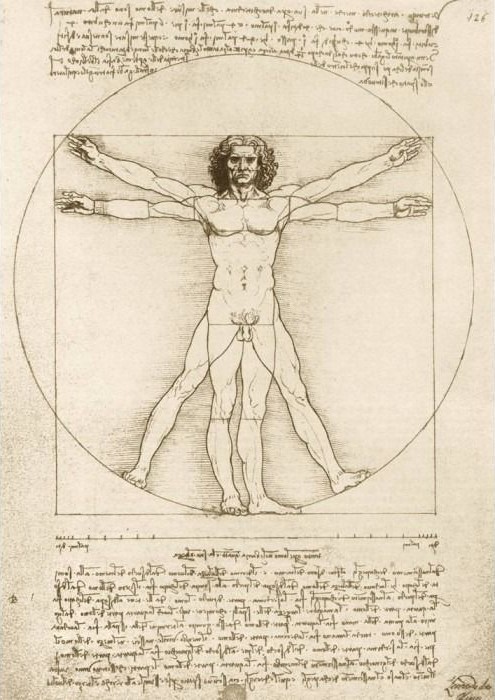
The central figure is a nude male presented in two superimposed positions. In the first position, his arms are extended horizontally and his feet are together, fitting within a square. In the second position, his arms are raised slightly and his legs are spread wide, aligning with the circumference of a circle. The anatomy is rendered with precise, realistic line work that emphasizes muscular definition and skeletal structure, capturing a sense of balanced proportions and movement.
The composition is strictly geometric, centering the figure within a circle which is itself enclosed in a square. The man’s facial expression is stoic and focused. The background is a plain, aged parchment tone, giving the illustration an antique, historical appearance. The drawing is crafted in fine, dark ink lines that create a stark contrast against the light paper.
The imagery is framed by extensive blocks of handwritten text in a mirrored script, positioned both above the square and below it. These notes, along with small linear measurements marked along the bottom, provide context to the anatomical study. The overall mood is academic, scientific, and artistic, reflecting a Renaissance-era exploration of human geometry and the harmonious relationship between man and the natural world.