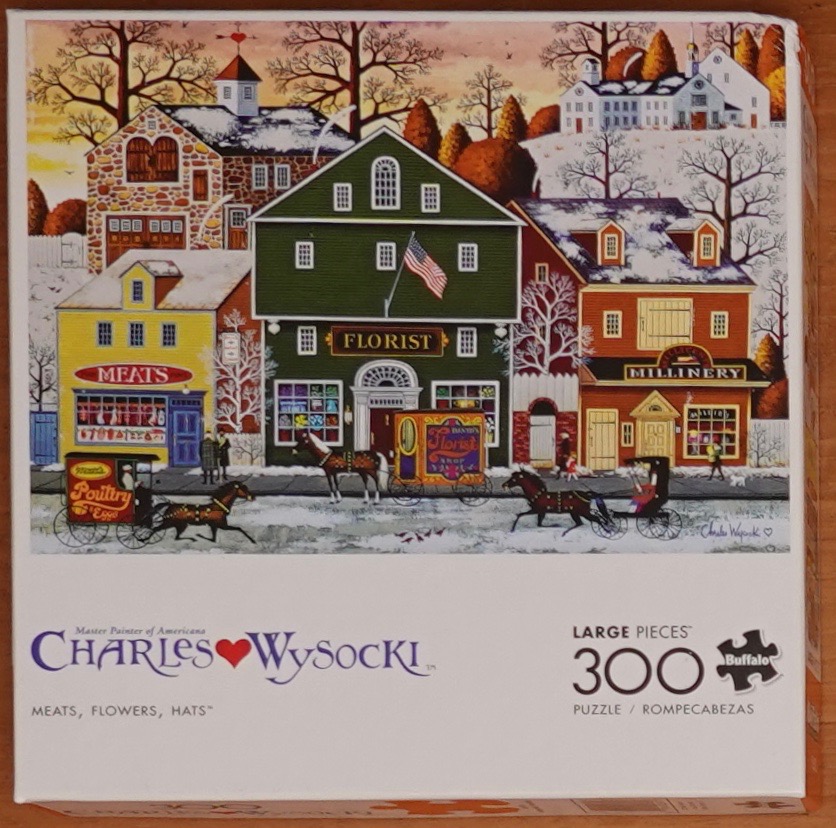
This scene depicts a quaint 19th-century American village during a light snowfall. The focal point is a row of colonial-style shops along a cobblestone street. A central green building serves as a florist, flanked by a yellow meat shop on the left and a rust-colored millinery on the right. Each storefront features period-appropriate signage and large, inviting display windows. Two horse-drawn carriages traverse the street, one carrying poultry and eggs while the other is marked for the florist.
Behind the shops, the village extends into a hilly landscape featuring a stone-faced building and a white church steeple in the distance. The composition is balanced and orderly, evoking a sense of historical nostalgia. Leafless trees dot the background, suggesting a crisp winter day, while the ground is dusted with a thin layer of snow. The overall spatial layout provides depth, drawing the eye from the busy street scene toward the peaceful, snow-dusted hillside.
The artwork utilizes a warm, vibrant color palette that contrasts with the white of the snow. The buildings are painted in rich ochre, deep green, and earthy red tones, which stand out against the soft, muted sky of twilight. The lighting suggests a glowing, golden hour, casting a cozy and peaceful atmosphere over the village. The illustration style is detailed and folksy, characteristic of American primitive art, with clean lines and a focus on charming, rhythmic architectural details.