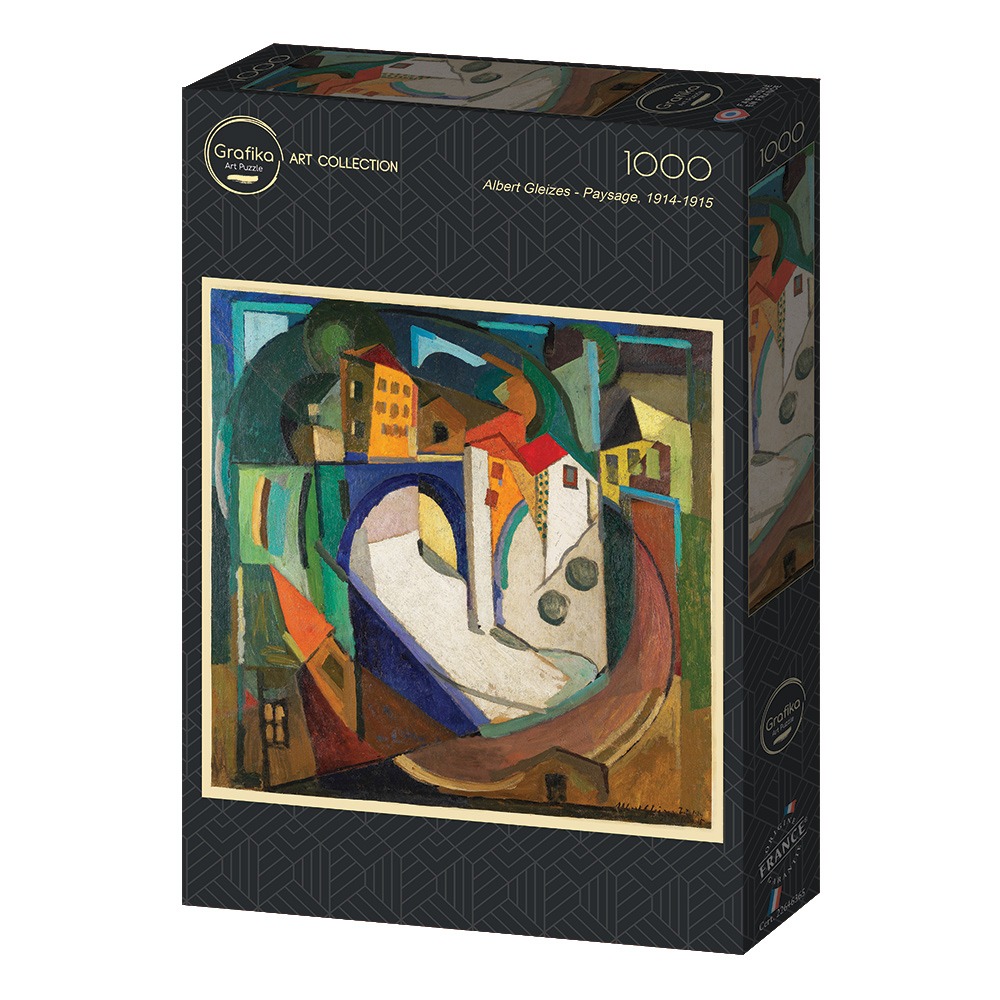
This artwork is a cubist-style landscape titled "Paysage, 1914-1915" by Albert Gleizes. The composition centers on a large, arched bridge or gateway that creates a sense of depth through a series of interlocking, non-representational planes. Surrounding this central structure are stylized houses and buildings, rendered as fractured geometric shapes that overlap and recede into the frame.
The colour palette is a balanced interplay between deep, cool tones and vibrant, warm accents. Dark blues, teals, and charcoal greys define the shadowy recesses and the bridge’s architecture, while bright oranges, ochres, and muted whites highlight the rooftops and building facades. These contrasting colours emphasize the angular and rhythmic nature of the Cubist perspective, breaking down the traditional horizon line into a dynamic, fragmented mosaic.
Technically, the painting exhibits visible, textured brushwork that reinforces the structural feel of the architecture. The scene lacks traditional vanishing-point perspective, opting instead for a flatter, more abstract representation that focuses on the interplay of light and form. The artist's signature is faintly visible in the bottom right corner, anchoring the composition within the history of early 20th-century European modernism.