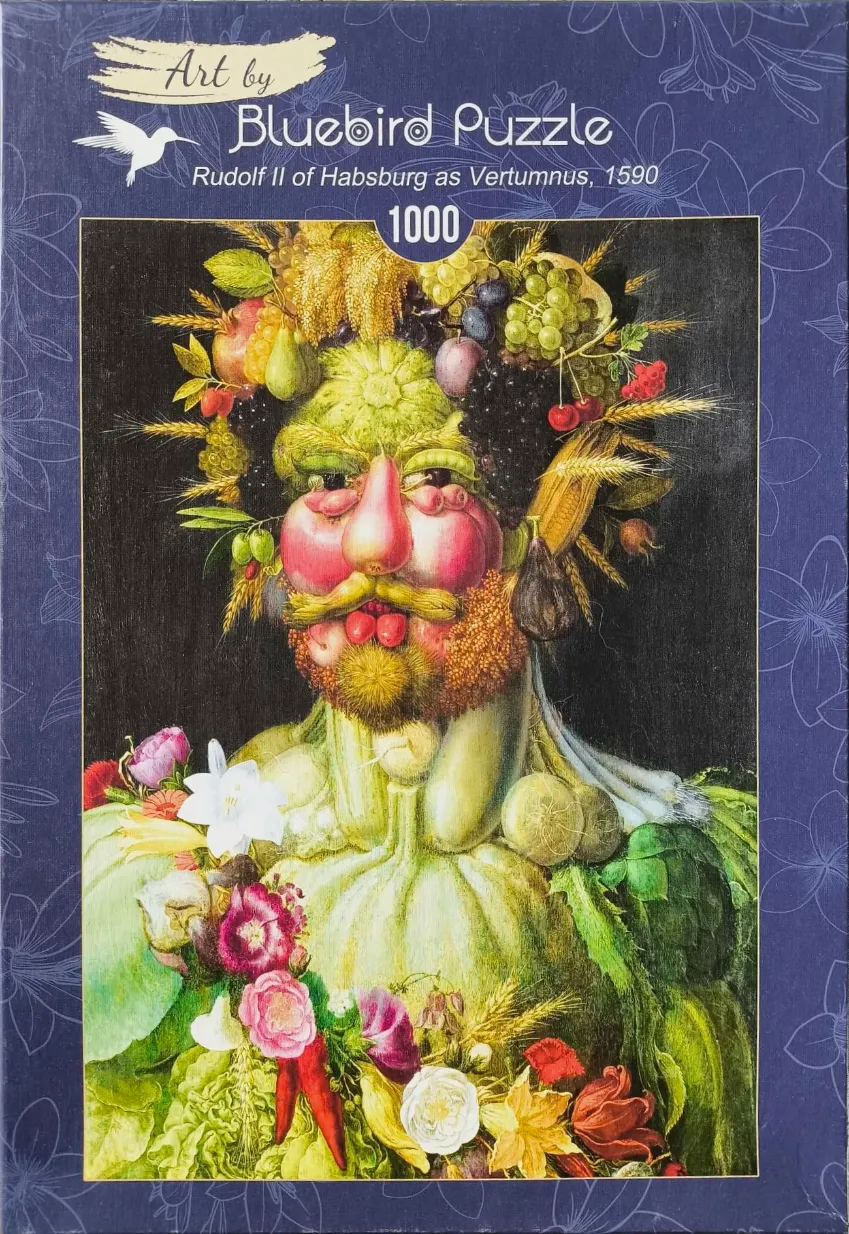
The image depicts a famous 16th-century portrait of a man, Rudolf II of Habsburg, represented allegorically as the Roman god Vertumnus. The entire composition is an anthropomorphic construction formed exclusively from an abundance of fruits, vegetables, and flowers. The subject's face is rendered with rosy cheeks made of apples, a nose of a pear, and a chin consisting of a spiky chestnut and various grains. His mustache and goatee are crafted from wheat stalks and other textured plant matter.
Set against a stark, pitch-black background, the figure stands in a bust-length pose. His shoulders and torso are composed of large squash, cucumbers, and leafy greens, with vibrant, blooming flowers—including white lilies, pink roses, and red blossoms—cascading across his chest and lapel. The arrangement is masterfully layered, creating the illusion of a man wearing elaborate, botanical-themed garments.
The color palette is rich and earthy, dominated by deep greens, vibrant reds, warm golden-yellows, and the soft whites and pinks of the floral elements. The contrast between the brilliant, natural hues of the produce and the absolute darkness of the background creates a striking, three-dimensional effect. Painted in the Mannerist style, this iconic work emphasizes texture and whimsical anatomical precision, transforming organic agricultural bounty into a lifelike and recognizable human form.