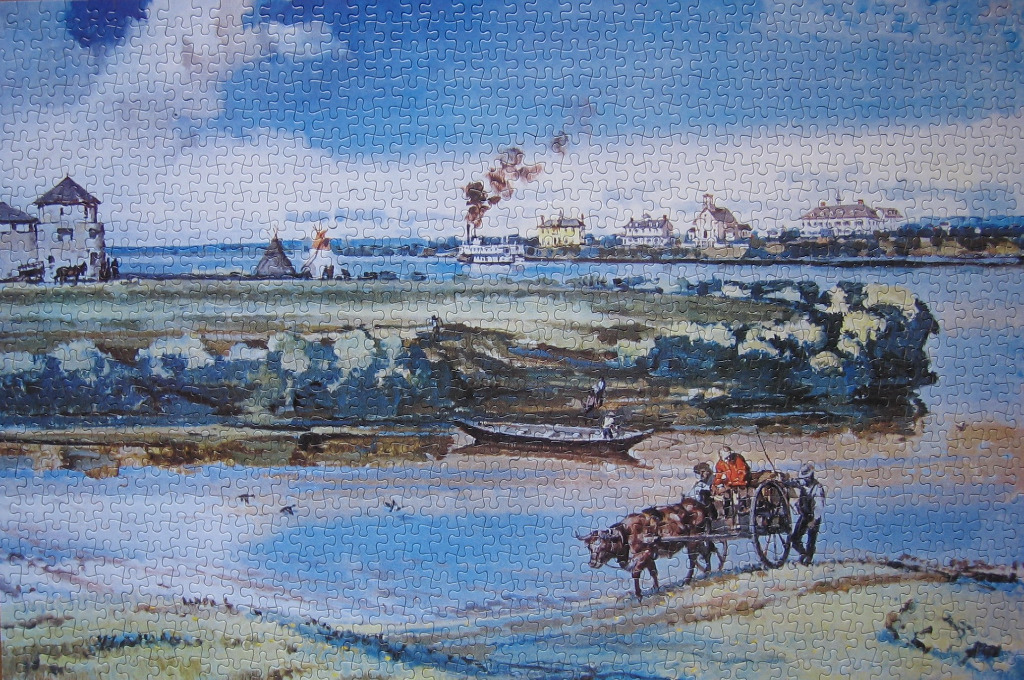
This historical landscape painting depicts a pastoral 19th-century river scene, likely near a developing town. In the foreground, a man guides a horse-drawn cart along the muddy banks of a shallow, slow-moving river. A small boat carrying figures is docked or passing by in the middle of the waterway, while the background reveals a quiet settlement featuring a prominent stone watchtower, small houses, and a steamboat chugging down the river with visible smoke trailing into the sky.
The composition follows a traditional panoramic layout, emphasizing the vast, open horizon of the river valley. The foreground bank provides a point of entry for the viewer, while the river acts as a horizontal anchor, pulling the eye toward the distant buildings. The sky is bright and expansive, filled with soft, white clouds that hint at a pleasant, breezy day, contrasting with the earthy tones of the riverbank.
The artistic style is impressionistic, characterized by loose, textured brushstrokes and a palette dominated by cool blues, soft greens, and warm ochres. Light is diffused, casting a soft glow over the landscape that evokes a nostalgic, turn-of-the-century atmosphere. The painting captures a sense of quiet daily labor set against a backdrop of frontier expansion and early industrial transformation.