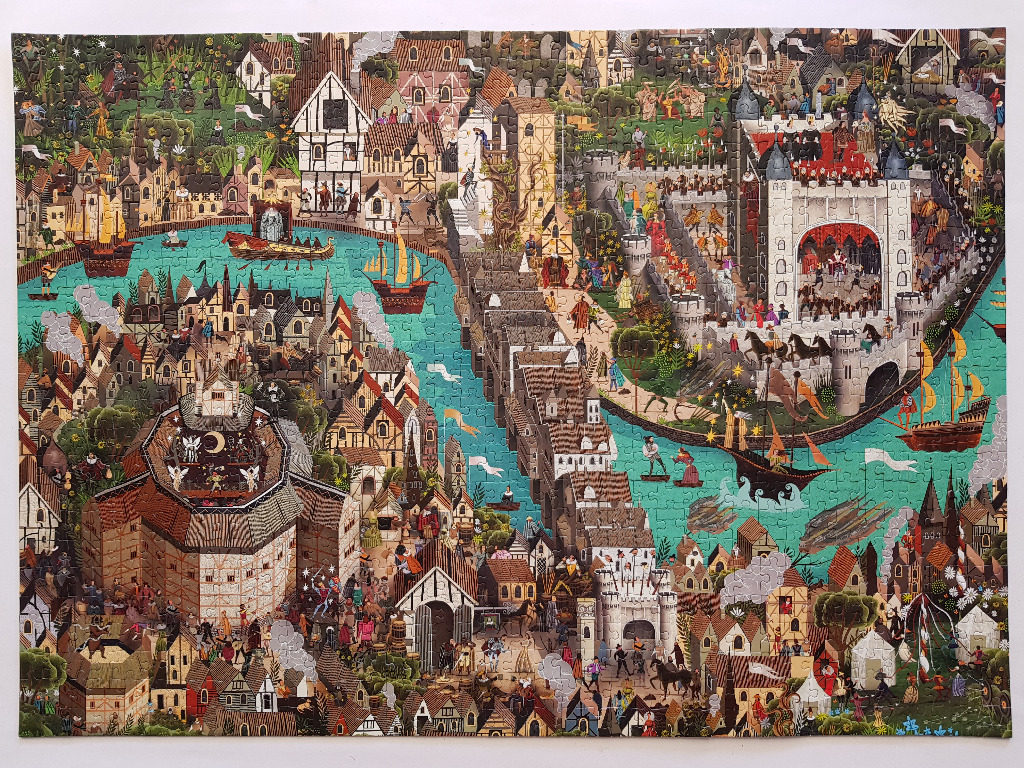
This highly detailed, stylized illustration depicts a bustling, vibrant Tudor-era city split by a winding river. On the left side stands a prominent, circular open-air theater with a visible stage, surrounded by densely packed timber-framed buildings and narrow streets. To the right, a massive stone castle dominates the landscape, featuring crenelated towers and an arched gateway where royalty or performers appear to be held in view. A grand, multi-arched stone bridge stretches across the water, connecting different segments of the town and providing a path for pedestrians and merchants.
The composition is busy and narrative-driven, filled with tiny vignettes of daily life, performers, soldiers, and townspeople dressed in historical garments. Tall sailing ships with intricate rigging navigate the teal-coloured river, adding a sense of movement and trade. The architectural style throughout is evocative of Elizabethan London, featuring gabled roofs, chimneys emitting plumes of smoke, and dark, muted tones of brown, charcoal, and ochre for the structures, which contrast against the bright, saturated blue-green water.
The artwork uses a flattened, storybook perspective, allowing for a wide-angle view of the entire scene. The light is even and shadow-less, typical of an illustrative folk-art style, focusing on clarity rather than realistic atmospheric effects. Small touches, like floating stars and whimsical character poses, imbue the scene with a sense of playful, historical fantasy.