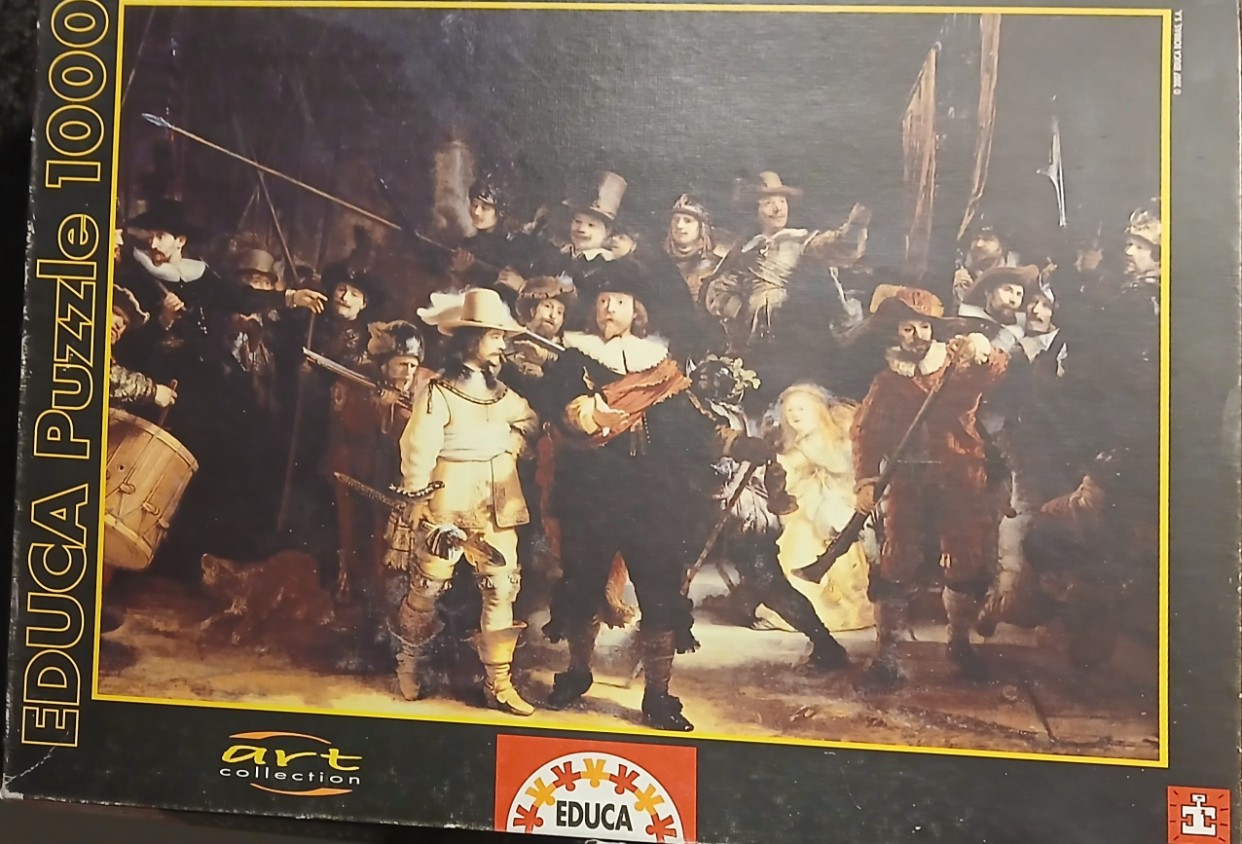
This masterpiece, commonly known as The Night Watch, depicts a company of civic guards moving out, led by their captain and lieutenant. The central figures are a man in a black coat with a red sash and his lieutenant, dressed in a bright yellow outfit with a white plumed hat. Surrounding them is a chaotic yet organized crowd of soldiers, musketeers, and a small, luminous young girl in a golden gown who acts as a focal point in the background, carrying a chicken hanging from her belt.
The scene is composed with dramatic movement and depth, showing the men in various states of preparation, including loading and firing muskets or carrying long pikes. The composition is dynamic, with overlapping figures creating a sense of a busy, crowded street. The background is shadowy and indistinct, suggesting a dark, architectural tunnel or city gate, which pushes the main subjects forward toward the viewer.
Technically, the painting utilizes dramatic chiaroscuro, with sharp contrasts between light and shadow. The light illuminates the captain and lieutenant, while other parts of the scene recede into deep browns and blacks. The palette is rich and earthy, dominated by deep umbers, ochres, and blacks, punctuated by vibrant bursts of yellow, red, and gleaming white lace collars. It is a traditional oil-on-canvas painting characterized by its realistic textures, detailed period clothing, and masterful manipulation of light and shadow to create narrative energy.