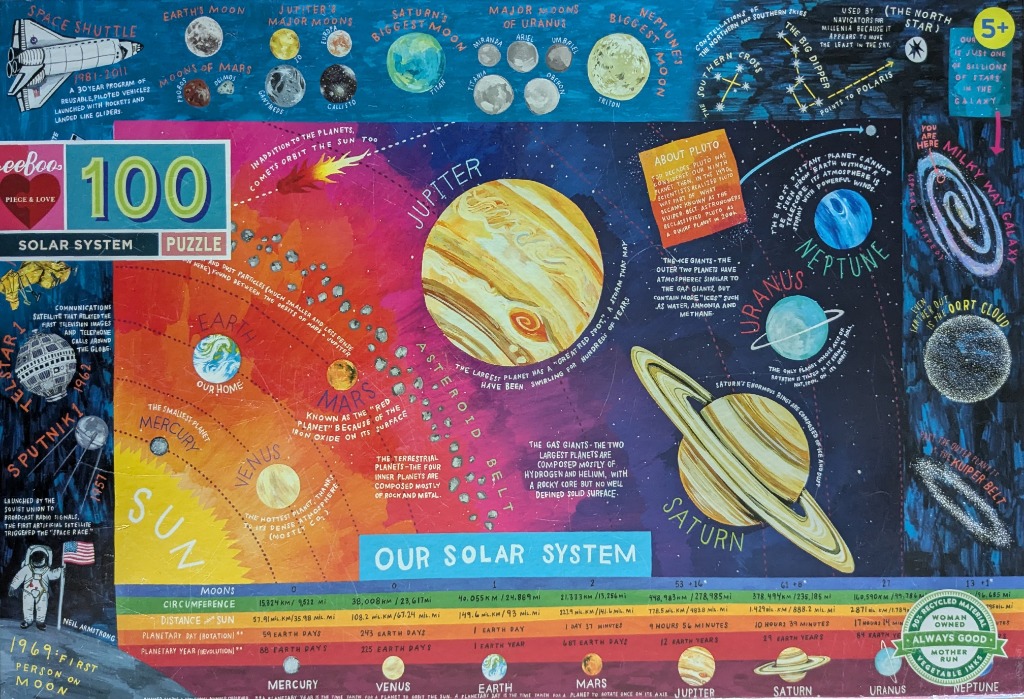
This educational illustration depicts the solar system through a vibrant, hand-drawn style. On the left, a bright yellow sun radiates warmth, leading outward to the terrestrial planets: Mercury, Venus, Earth, and Mars. These are separated from the outer gas giants by a detailed asteroid belt. Jupiter, with its iconic Great Red Spot, sits centrally, while Saturn, with its prominent rings, Uranus, and Neptune occupy the right side. The background transitions from a fiery orange near the sun to a deep, dark blue space filled with white star speckles.
The composition is highly informative, functioning as a celestial infographic. The top section showcases various moons of the solar system, the Milky Way galaxy, and the constellations of the northern and southern skies. Educational text is scattered throughout the image, explaining planetary characteristics, space travel history, and astronomical phenomena like the Oort Cloud and the Kuiper Belt. A Space Shuttle and a depiction of Neil Armstrong on the moon provide historical context regarding human space exploration.
At the bottom of the scene, a comprehensive data table provides scientific facts for each planet, including circumference, distance from the sun, and the duration of their days and years. The artwork uses a bold, playful palette with contrasting warm yellows, oranges, and reds against a cool, dark blue backdrop. The overall aesthetic is that of a colorful, hand-painted science poster, blending artistic expression with astronomical information.