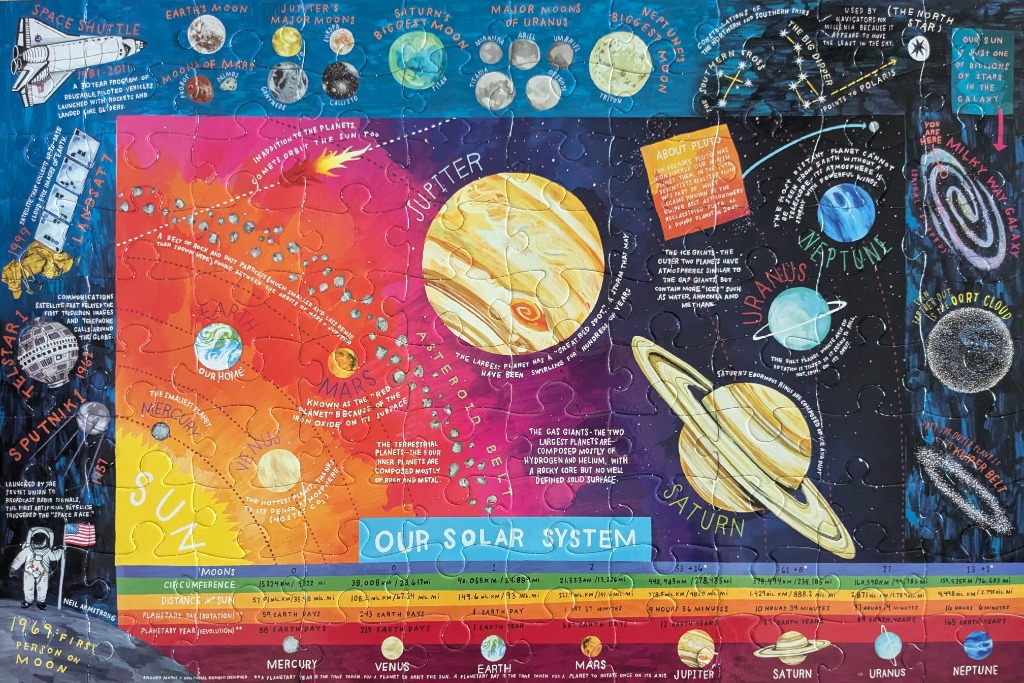
This educational illustration depicts the solar system in a vibrant, artistic layout. The central focus is a large, detailed Jupiter surrounded by other planets including Saturn with its prominent rings, Earth, Mars, Venus, Mercury, Neptune, and Uranus. These celestial bodies are set against a colorful background that transitions from warm oranges and yellows near the Sun to deep purples and blues representing the vastness of space. An asteroid belt is depicted as a cluster of rocky fragments between Mars and Jupiter.
Surrounding the planets are various informative elements, including smaller illustrations of moons, the Milky Way galaxy, the Oort cloud, and a space shuttle. On the left, a small figure of Neil Armstrong stands with an American flag, while Sputnik 1 and Telstar 1 are labeled. Dotted lines trace the paths of comets and provide visual connections between scientific concepts. A detailed data table at the bottom summarizes the circumference, distance from the sun, and the length of days and years for each of the eight planets.
Textual labels and informative blocks are scattered throughout, written in a clear, hand-lettered style. The overall composition is reminiscent of a science classroom poster, combining accurate astronomical subjects with a playful, illustrative aesthetic. The color palette is bold and educational, using high-contrast tones to distinguish between the inner terrestrial planets and the outer gas giants, creating a lively and engaging overview of the cosmos.