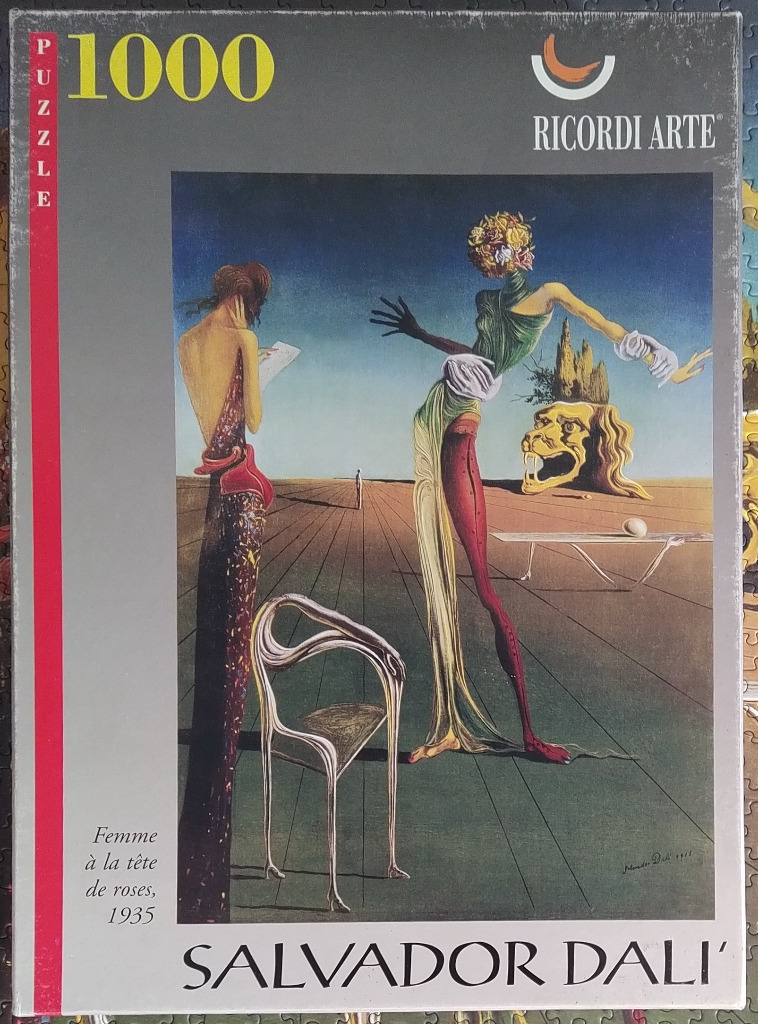
This surrealist oil painting depicts a vast, desolate landscape stretching toward a hazy, blue-toned horizon. In the foreground, a slender, elongated woman stands with her arms outstretched, her head replaced by a cluster of vibrant, colorful roses. She wears a flowing, multi-colored garment that transitions from green to deep red. To her left, a second, more classically rendered figure with a bare back stands at an angle, appearing to read or write on a small white sheet. Between them, a distorted, melting chair stands on thin, spindly legs, echoing the surreal aesthetic.
The setting is characterized by a flat, wooden-plank floor that recedes into the distance, where a tiny, solitary human figure stands near the horizon line. To the right of the central woman, a large, stone-like lion's head lies on the ground, its mouth agape and eyes closed, while a simple, minimalist white table holds a single, smooth egg-shaped object. In the far distance, faint architectural or natural forms rise against the darkening sky.
The color palette is moody and atmospheric, contrasting the earthy, warm browns and deep reds of the figures and the floor against the cool, gradient blues of the sky. The lighting is dreamlike and unnatural, casting long, soft shadows across the plane. The style is classic surrealism, defined by crisp, detailed rendering of bizarre, impossible subjects arranged in a hyper-realistic, yet utterly dreamlike space, characteristic of the mid-1930s era.