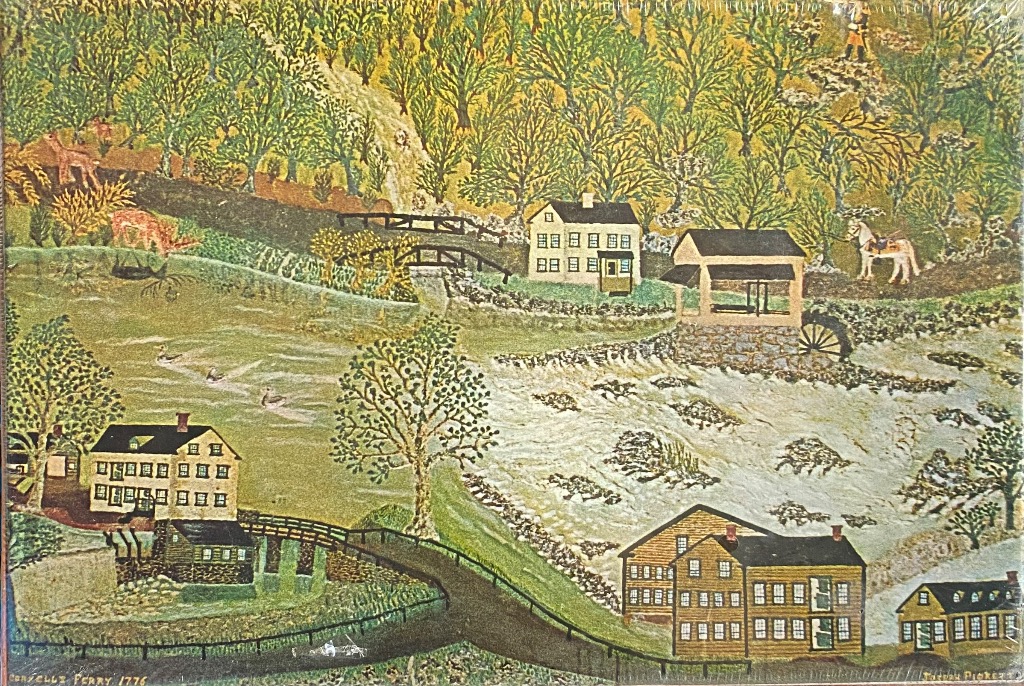
This folk art scene depicts a colonial-era riverside settlement known as Coryell's Ferry in 1776. The landscape is dominated by a bustling community featuring several large, multi-story houses painted in muted cream and yellow tones with dark rooftops. A stone water mill with a visible wheel sits prominently near a turbulent, frothing river that cuts across the lower right section of the composition. A wooden bridge spans a smaller stream, connecting the rolling terrain.
Nature surrounds the architecture, with a dense forest of stippled green trees covering the background hills. The scene is populated with various figures and animals, including a lone rider on a white horse near the mill, several deer grazing on the hillsides, and waterfowl swimming in the calmer waters of the river. The perspective is slightly elevated, typical of folk art, allowing for a clear view of the winding paths and the spatial relationship between the houses, the river, and the surrounding woodland.
The artwork uses a textured, painterly style that emphasizes decorative detail over realistic proportions. The colour palette is earthy, dominated by shades of forest green, sandy beige, and soft brown, reflecting the natural setting of the period. Light appears even and diffuse across the scene, creating a peaceful, historical atmosphere. The bottom left corner includes the text "CORYELL'S FERRY 1776," while the bottom right corner features the signature "JOSEPH PICKETT."