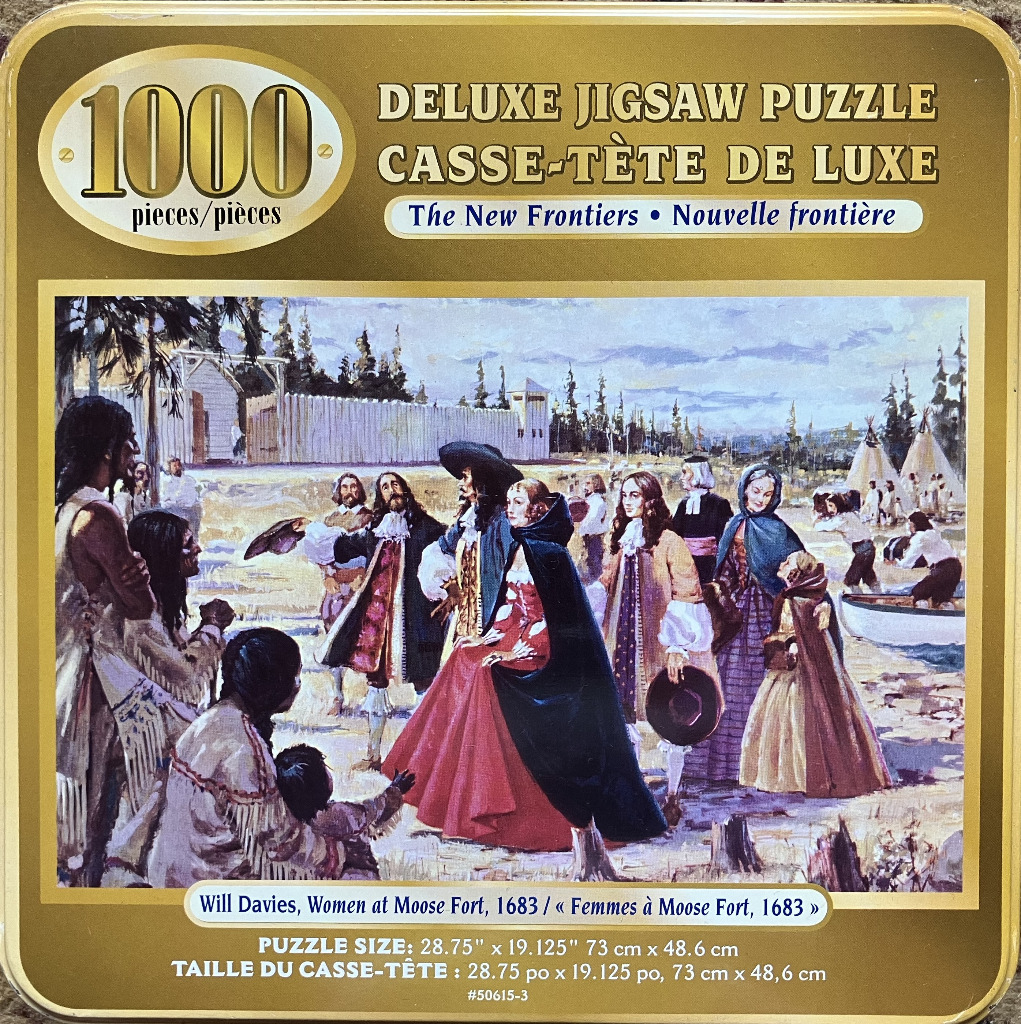
This historical illustration depicts a scene at Moose Fort in 1683, capturing an encounter between European settlers and Indigenous people. In the foreground, a group of figures dressed in seventeenth-century European finery—including a man in a wide-brimmed hat and a woman in a dramatic dark blue cloak and red gown—stand near an Indigenous group. A person in traditional fringed leather clothing holds a small child, creating a focal point of cultural intersection. Other figures in period-appropriate coats and dresses dot the scene, suggesting a formal or significant exchange.
The setting is an open, grassy clearing bordered by a tall wooden palisade and forest in the background. To the right, the landscape opens up towards a shoreline where a canoe is visible near a group of tepees, indicating the proximity of a river or bay. The composition is horizontally balanced, with the European nobility positioned centrally and Indigenous community members framing the left and right edges.
The artwork is rendered in an impressionistic, painterly style with visible brushwork and a muted, naturalistic palette. Earthy browns, forest greens, and soft sky blues dominate the landscape, while the vibrant red of the woman's dress provides a bold visual anchor. The lighting is diffused, suggesting a bright, overcast day, casting soft shadows that enhance the depth and textured quality of the garments and the surrounding wilderness.